
Choosing a managed IT services provider (MSP) can feel a bit like hiring a long-term business partner because that’s exactly what you’re doing. The right MSP keeps your systems secure, your teams productive, and your technology aligned with your business goals. The wrong one? Missed SLAs, surprise costs, and constant firefighting.
With so many types of managed IT services providers in the market each offering different service models, specialisations, and pricing structures it’s easy to get overwhelmed. From fully managed IT partners to niche providers focused on security or cloud, understanding your options is the first step toward making a smart decision. In this guide, we’ll break down the main types of MSPs and show you how to choose the right one for your business size, industry, and growth plans.
Mapping the MSP ecosystem: definitions, service tiers, and provider categories
Managed IT services encompass proactive, subscription-based support for your IT infrastructure, applications, endpoints, and security controls. A managed service provider (MSP) assumes day-to-day operational responsibility, often blending IT consulting, automation, and business operations support to meet agreed service levels.
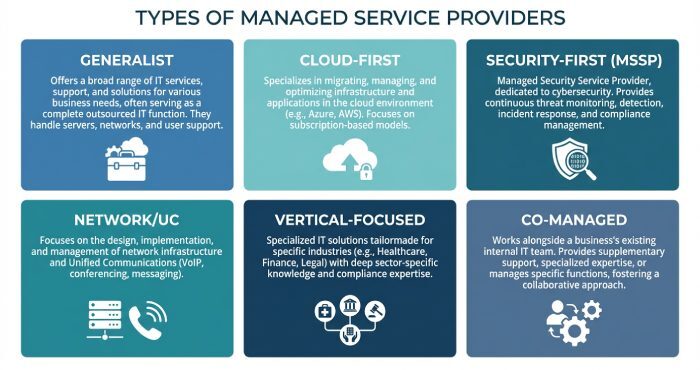
Definitions:
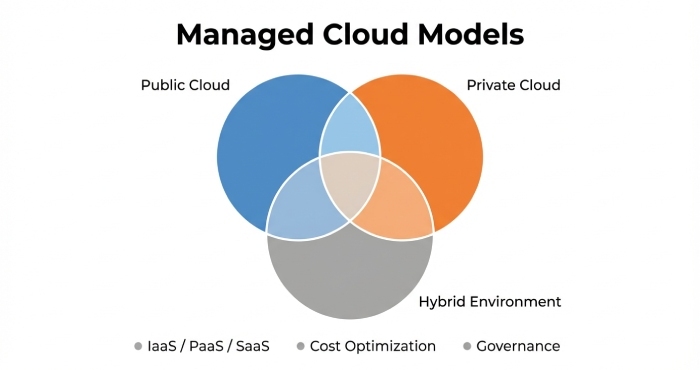
- Managed Service Provider (MSP): An organisation that delivers ongoing managed IT services such as monitoring, patching, help desk, device management, and managed cloud services across public cloud, private cloud, and hybrid cloud environments.
- Managed Security Service Provider (MSSP): A security-first MSP specialising in managed security services, including threat detection and response, vulnerability management, risk assessment, and compliance monitoring.
Service tiers commonly seen in types of managed IT services:
- Foundational: Remote monitoring and management (RMM), help desk, patching, backups.
- Advanced: Managed cloud services (IAAS/PAAS/SAAS), network/UC, cybersecurity services, data backup and disaster recovery.
- Strategic: IT consulting, IT strategy road mapping, technology strategy, and a virtual Chief Information Officer (vCIO) to guide long-term decisions.
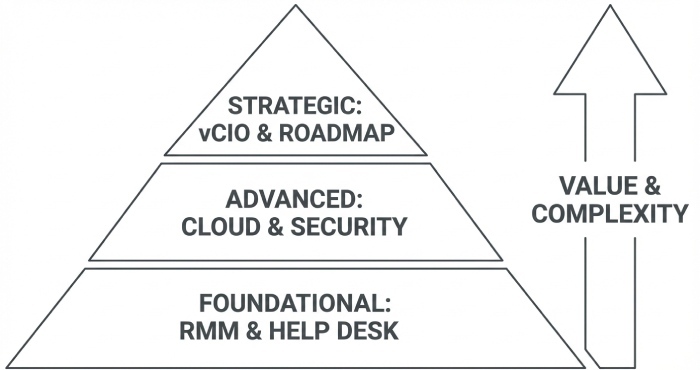
The main MSP types and when to use each (generalist, cloud-first/CSP, security-first/MSSP, network/UC, vertical/app-focused, co-managed)
- Generalist MSPs: Best for small to mid-sized organisations needing broad managed IT services across endpoints, servers, and basic cloud services. Choose when you need a single partner for help desk, routine maintenance, data protection, and business continuity without deep specialisation.
- Cloud-first/CSP: Cloud solution providers excel in managed cloud services across Public Cloud, Private Cloud, and Hybrid Cloud. Engage a cloud-first MSP when migrating workloads to IAAS/PAAS/SAAS, optimising cloud services costs, or architecting hybrid cloud landing zones. They should address connectivity (Dedicated Connections, VPN) and governance policies.
- Security-first/MSSP: Select an MSSP when your priority is cybersecurity services, such as managed detection and response, vulnerability management, and incident handling. This type is ideal for regulated sectors requiring rigorous compliance monitoring and advanced threat detection and response.
- Network/UC-focused: For complex WAN, SD-WAN, Wi‑Fi, VoIP, and unified communications (UC) needs, use an MSP with deep network engineering. They often bundle monitoring, quality-of-service, VPN, and contact-center features that bolster customer engagement strategies.
- Vertical/app-focused: If you need industry-specific IT services, pick a provider with domain expertise e.g., healthcare IT services (integrating Electronic Health Record (EHR) systems), financial IT services (controls for SOX/GLBA), legal IT services (NetDocuments for cloud-based document management), insurance IT services, or real estate IT services. These MSPs often manage line-of-business platforms and a document management system and provide targeted IT consulting.
- Co-managed partners: For mid-market and enterprise teams that want to keep strategic control while offloading operations, co-managed MSPs augment internal staff. Use this model to extend 24/7 coverage, expand managed cloud services, and accelerate IT outsourcing without losing architectural oversight.
Assessing your business needs to match the right MSP type (size, complexity, compliance, 24/7 coverage, cloud maturity, budget)
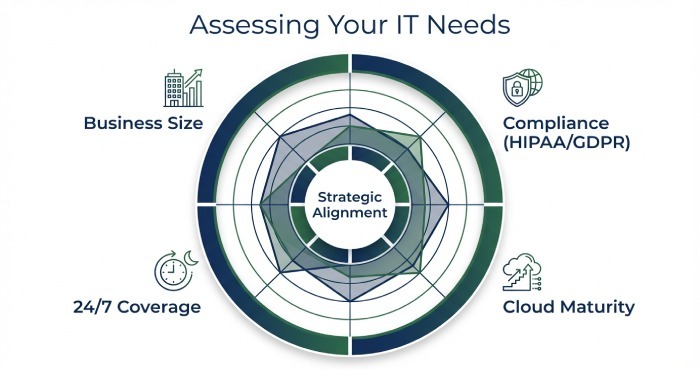
- Size and complexity: Inventory your IT infrastructure, application footprint, and integration needs (including Application Programming Interface (API) dependencies). Larger, distributed environments typically benefit from co-managed or specialised MSPs.
- Compliance and industry: Map requirements (HIPAA, PCI DSS, SOX, GDPR) to provider capabilities. Healthcare IT services should demonstrate EHR integration experience; legal IT services should support NetDocuments and defensible data protection workflows; financial IT services must validate audit trails and policy enforcement.
- 24/7 coverage and business continuity: If uptime is critical, prioritise MSPs with global NOC/SOC and clear RTO/RPO definitions for data backup and disaster recovery. Confirm how they maintain business continuity across public cloud, private cloud, and hybrid cloud outages.
- Cloud maturity: Organisations early in their journey should consider cloud-first MSPs offering assessments and landing zones across Public Cloud and Private Cloud. Mature teams may require optimisation and governance for Hybrid Cloud, multi-account segmentation, cost controls, and managed cloud services like security baselines and logging.
- Budget and IT outsourcing strategy: Decide which outsourced IT services you truly need. A generalist MSP can bundle essentials economically, while a security-first MSSP or vertical specialist may command a premium. Balance IT outsourcing savings against strategic IT consulting services, vCIO guidance, and long-term return on investment(ROI).
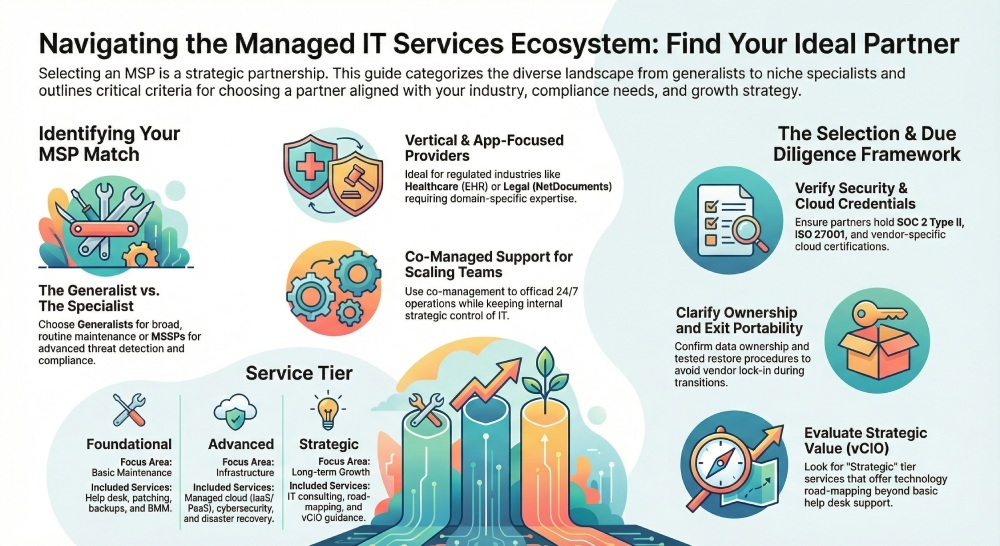
Selection criteria and due diligence checklist (SLAs, tooling stack, security posture, certifications, onboarding, support model)
- SLAs and support model: Evaluate response/restoration targets, escalation paths, 24/7 availability, and named technical contacts. Ask how SLAs are met for cloud services spread across Public Cloud, Private Cloud, and Hybrid Cloud footprints.
- Tooling stack and integrations: Review RMM/PSA, backup, EDR/XDR, and cloud management platforms. Validate API support for integrating ticketing, alerting, and automation into your workflows. Confirm support for IAAS, PAAS, and SAAS, plus connectivity like Dedicated Connections and VPN.
- Security posture and certifications: Ensure zero-trust design, hardening baselines, and continuous monitoring. An MSS-capable partner should show evidence of threat detection and response pipelines, vulnerability management cadences, risk assessment reports, and compliance monitoring aligned to your sector.
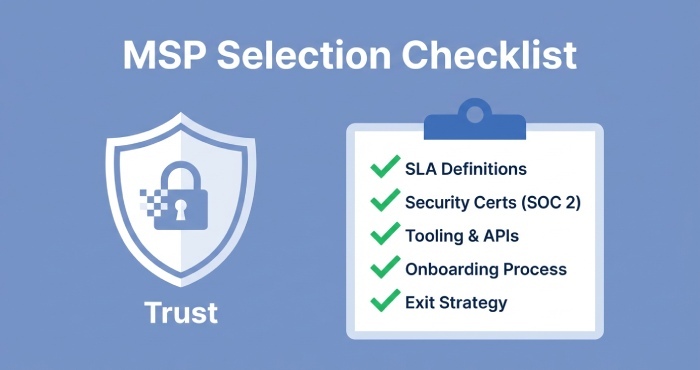
Core certifications to verify
Security frameworks
- SOC 2 Type II, ISO 27001, PCI DSS, and HIPAA competency for regulated workloads
Cloud credentials
Azure/AWS/GCP professional-level, plus vendor badges for Public Cloud, Private Cloud, and Hybrid Cloud architectures
- Onboarding and strategy: Examine discovery, documentation quality, and the vCIO process. Strong MSPs include IT strategy road mapping that aligns technology strategy to business goals, including cost modeling, lifecycle plans, and automation opportunities.
- References and case studies: Ask for industry-matched examples e.g., Matrix Solutions supporting Hybrid Cloud migrations, or a legal services reference showcasing NetDocuments rollouts and a cloud-based document management transition.
Pricing models, contracts, and red flags (per-user/device vs tiered, inclusions/exclusions, KPIs, exit and data ownership, lock-in)
- Per-user/device vs tiered: Per-user pricing is predictable for endpoint-heavy environments; per-device can favor infrastructure-centric estates. Tiered bundles scale from essentials to fully managed cloud services, often combining managed security services and IT consulting.
- Inclusions/exclusions and KPIs: Clarify what’s standard versus billable onsite visits, after-hours support, project work, public cloud cost management, private cloud hosting fees, and hybrid cloud network design. Establish KPIs for uptime, ticket SLAs, patch compliance, and backup success rates.
- Exit, data ownership, and lock-in: Confirm data ownership, access to configurations/runbooks, and portability of backups. Ensure the MSP’s document management system administration, cloud services tenancy, and security tooling remain portable. Validate tested restore procedures for data backup, disaster recovery, and data protection across providers. Watch fees for cloud egress, Dedicated Connections, or virtual private network(VPN )termination.
Contract gotchas and warning signs: Look for fair termination clauses, clear onboarding timelines, and transparent change management. Red flags include vague SLAs, lack of SOC 2/ISO attestations, no evidence of managed security services, and limited experience spanning Public Cloud, Private Cloud, and Hybrid Cloud. An MSP that cannot articulate a vCIO-led roadmap or provide IT consulting services tailored to your industry likely won’t scale with you.