
In Melbourne’s highly competitive business environment, the ability to manage IT challenges effectively can be the difference between progress and stagnation. For small businesses, downtime caused by technical issues or system failures has a direct impact on productivity, customer service, and overall profitability. Reliable and responsive IT support, tailored to the specific needs of Melbourne’s small business sector, helps keep operations running smoothly, addresses security threats promptly, and safeguards critical business data.
A dependable IT partner provides more than just quick fixes it delivers proactive support and responsive services tailored to the day-to-day needs of local business operations. From real-time monitoring to on-site assistance, a Melbourne-based IT support provider understands the unique challenges faced by businesses operating within Australia’s constantly evolving technology landscape. Whether it’s a minor issue or a network-wide outage, access to expert support helps minimise disruption and maintain business continuity.
Same-Day Service Defined: SLAs, Response Tiers, and Dispatch Workflow
What is Same-Day IT Support?
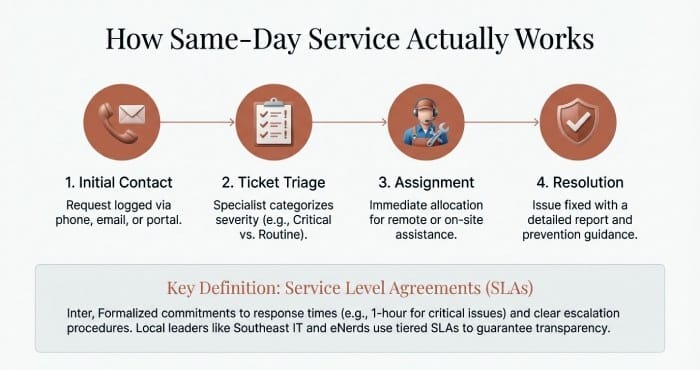
Same-day service is a key standard of responsive IT support, ensuring that technical issues are resolved within hours often before they can develop into more serious disruptions. For small businesses in Melbourne, this commitment is formalised through Service Level Agreements (SLAs) that clearly define response times, resolution targets and escalation procedures.
Service Level Agreements (SLAs) and Response Tiers
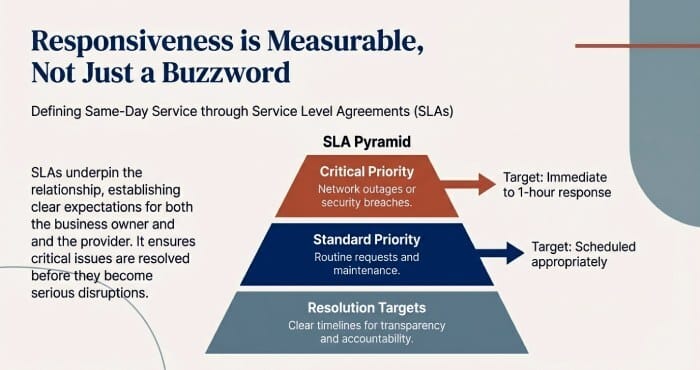
Service Level Agreements (SLAs) underpin same-day support by establishing clear expectations for both the small business owner and the IT provider. They generally outline:
- Guaranteed response times (for example, a one-hour response for critical IT issues)
- Priority levels, where urgent problems such as network outages receive immediate attention, while routine requests are scheduled appropriately
- Resolution targets that promote transparency and accountability
For instance, leading local providers such as Southeast IT and eNerds offer tiered SLAs supported by teams of experienced technicians and strong network management systems.
Dispatch Workflow: From Request to Resolution
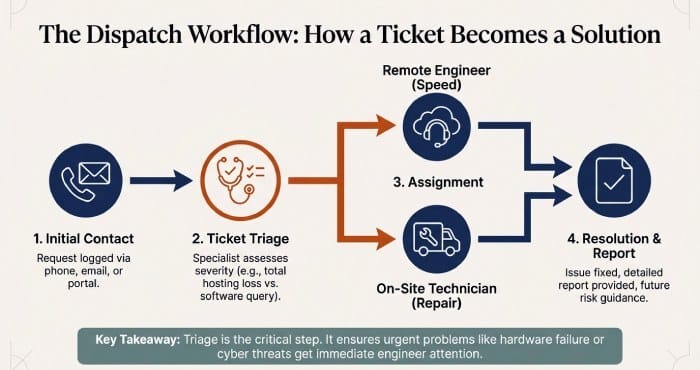
When an IT issue is reported, the support process follows a clear dispatch workflow:
- Initial contact: The helpdesk team logs the request via phone, email, or an online portal, gathering the necessary details for troubleshooting.
- Ticket triage: An IT specialist assesses and categorises the issue by severity for example, loss of website hosting, an urgent data backup failure, or a customer management system outage.
- Assignment: For critical incidents, an engineer or technical support team member is allocated for same-day assistance, either on site or through remote support.
- Resolution and follow-up: The technical team works towards a solution using expertise in areas such as website hosting, secure backups, and network infrastructure. Once resolved, the IT provider typically supplies a detailed report along with guidance to help reduce future risks.
For urgent situations such as hardware failures, networking equipment breakdowns or potential cyber security threats the priority is to minimise downtime and restore system functionality within the agreed timeframes.
Common IT Pain Points for Melbourne SMEs and How to Fix Them Fast
Recurring Challenges Facing Local Small Businesses
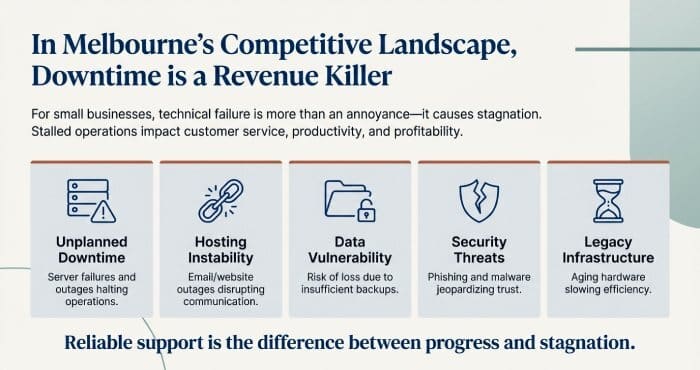
Small and medium-sized businesses (SMEs) in Melbourne frequently face a variety of IT challenges that can affect productivity and profitability. Common pain points include:
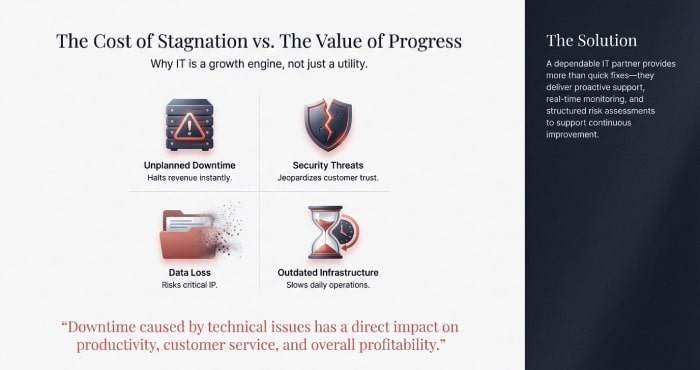
- Unplanned downtime: From server failures to cloud platform outages, downtime disrupts operations and can lead to lost revenue.
- Email and website hosting issues: Outages or configuration problems interfere with communication and customer engagement.
- Data loss and insufficient backups: Without secure backups and reliable data backup processes, critical business information is at risk.
- Cyber security threats: Phishing attacks, malware, and weak security practices place both customer and business data in jeopardy.
- Outdated IT infrastructure: Ageing computers, unsupported software, legacy network equipment, and poorly managed hardware or software inventories contribute to reduced efficiency.
Fast Fixes: Proactive and Responsive Solutions
A Melbourne IT support provider addresses these challenges through a combination of proactive support and rapid troubleshooting:
- Real-time monitoring and automated alerts: Network monitoring tools notify the technical support team of potential issues before they impact the business, allowing for proactive resolution.
- Cloud solutions and backup strategies: Migrating to cloud services such as Microsoft 365 and implementing cloud backup safeguards against data loss, and simplifies disaster recovery.
- Structured risk assessments: Regular IT audits identify weaknesses in technology management, security standards, and system performance, supporting continuous improvement.
- helpdesk support and remote assistance: Immediate access to IT support reduces waiting times, while expert guidance ensures efficient troubleshooting of technical issues.
- Comprehensive IT solutions: A combination of local on-site services and 24×7 support delivers the flexibility required by growing businesses.
Support Models Compared: Break-Fix, Managed IT, and Co-Managed Options
Break-Fix IT Support
This traditional model provides IT assistance on an as-needed basis, with charges applied for each troubleshooting or repair task. While suitable for businesses with limited IT infrastructure, the break-fix approach can result in unpredictable costs and prolonged downtime when complex technical issues arise.
Pros
- Cost-effective for infrequent IT issues
- No ongoing contract required
Cons
- No proactive support or real-time monitoring
- Increased likelihood of recurring IT problems due to the absence of preventative maintenance
Managed IT Services
A managed services provider offers comprehensive Melbourne IT support, including proactive monitoring, routine maintenance, helpdesk assistance, and solution-focused service packages.
Pros
- Predictable monthly fees with broad, all-inclusive coverage
- Ongoing monitoring, automated alerts, and effective network management
- Regular infrastructure audits, compliance with security standards, and timely system updates
Cons
- Higher ongoing costs compared with ad hoc support options
- Requires a trusted small business IT support Melbourne partner with proven experience supporting Melbourne small businesses
Co-Managed IT Solutions
Some growing SMEs choose a co-managed IT approach, supplementing their in-house IT team with external technical expertise.
Pros
- Scalability and flexibility through a combination of internal and external resources
- Access to advanced skills in areas such as infrastructure audits, disaster recovery, risk management, and migration to the cloud
Cons
- Requires effective coordination between internal and external teams
- Integration of tools and reporting processes can be more complex
Choosing the Right Model
Melbourne businesses should assess their size, internal capabilities, risk profile and future growth plans when choosing an IT solutions model. Providers such as eNerds and Geeks2U deliver tailored service options to suit a range of needs from start-ups seeking cost-effective IT support to established organisations requiring fully managed services.
helpdesk, Remote, and On-Site Support: When Each Is Best
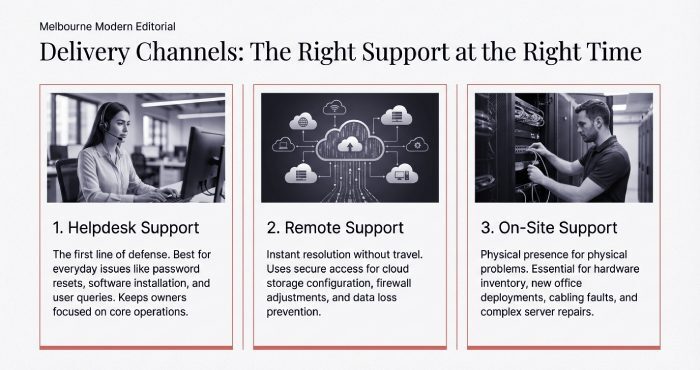
Helpdesk Support
When to Use: Everyday IT Issues & Software Assistance
Helpdesk support is the first line of defence against routine technical issues such as password resets, software installation, website hosting troubleshooting and everyday user queries. A well-trained helpdesk team, whether local or part of a global provider, minimises disruptions and enables small business owners to stay focused on their core business operations.
Remote Support
When to Use: Instant Problem Resolution & Cost Savings
Remote solutions allow IT specialists to resolve issues immediately without the need for travel, improving productivity and supporting more cost-effective IT management. By using secure remote access technologies, support staff can assist with:
- Cloud storage configuration
- Network setup and firewall adjustments
- Cloud platform management
- Data loss prevention procedures
On-Site Support
When to Use: Hardware, Networking, & Complex System Failures
Certain IT issues such as networking equipment installation, hardware setup, computer repairs, or cabling faults require a physical presence. On-site services are essential for:
- Comprehensive infrastructure audits and hardware inventory
- New office technology deployments
- Major server repairs or upgrades
- Legacy system migrations and complex troubleshooting
Leading Melbourne IT providers, including Southeast IT, offer a combination of helpdesk, remote, and on-site services, supported by 24×7 availability and no-fix, no-fee guarantees for added peace of mind.
By utilising a blend of expert guidance and flexible Melbourne IT support models backed by responsive service and strong IT infrastructure management small businesses across Melbourne can build a solid foundation for efficiency, sustainable growth, and future-ready technology management.
Cybersecurity Must-Haves for SMBs: Essential Eight, MFA, EDR, and Staff Training
The Critical Role of Cybersecurity in Small Business IT Support
For Melbourne small businesses, cyber security is no longer a luxury it is an absolute necessity. The growing number of cyber threats and technical challenges targeting SMEs requires proactive support and strong risk management practices from IT providers. Trusted IT partners such as eNerds, Southeast IT and other specialised Melbourne IT support firms consistently emphasise that effective IT services begin with layered security strategies designed around the real-world needs of small business operations.
Implementing the ACSC Essential Eight
The Australian Cyber Security Centre (ACSC) introduced the Essential Eight as a baseline framework for organisational cyber security. Small business IT support should prioritise the implementation of these controls, which include:
- Application whitelisting and patching: Regular software updates and monitoring of software inventories help prevent known exploits.
- User privilege management: Restricting access reduces the potential impact of security breaches.
- Office technology protections: Ensuring systems use multi-factor authentication (MFA) and secure configurations further minimises vulnerabilities.
A thorough infrastructure audit conducted by your IT provider can identify compliance gaps within the existing IT environment and provide clear guidance for remediation.
Multi-Factor Authentication (MFA) and Endpoint Detection & Response (EDR)
Modern IT solutions incorporate multi-factor authentication (MFA) across cloud platforms such as Microsoft 365, Google Workspace and others significantly strengthening business continuity by preventing unauthorised account access. At the same time, Endpoint Detection and Response (EDR) tools allow technical support teams to monitor devices for suspicious activity, enabling faster threat detection and mitigation.
Melbourne IT support teams, including those at Geeks2U and NerdSuite Software, recommend integrating EDR into managed services to support real-time monitoring, automated alerts, and detailed reporting on attempted threats. EDR also supports rapid data recovery following ransomware incidents—a common technical challenge for small and medium-sized businesses.
Ongoing Staff Training and Security Awareness
Even the most effective technology management practices can be compromised by human error. Regular cyber security training helps staff recognise phishing, ransomware, and social engineering attempts, reducing risk and maintaining system integrity. IT helpdesk support should coordinate ongoing, engaging security awareness sessions to strengthen the organisation’s overall risk posture.
Cloud and Productivity Platforms: Microsoft 365 and Google Workspace Done Right
Streamlined website hosting and Website Hosting
Many small businesses depend on cloud services such as Microsoft 365 or Google Workspace to manage their productivity requirements, from website hosting to document collaboration. Choosing the right platform and configuring it effectively is essential a process best guided by an experienced team of specialists. Melbourne IT support providers assist with software setup, migration to the cloud and system integration, helping to ensure maximum uptime and minimal technical issues.
Proper Cloud Storage and Cloud Backup Management
Effective technology management involves more than simply setting up cloud storage it requires ongoing network management, user access control and secure backups. Regular data backup is essential for business continuity, with automated solutions helping to reduce the risk of data loss or downtime. A capable IT team or managed services provider will deliver backup solutions designed for scalability and reliability.
Maximising Productivity and Efficiency
Cloud platforms deliver the greatest value when they are tailored to specific business operations. Expert support with system updates, workflow automation, and customer management system integrations can lead to significant productivity gains and cost savings. NerdSuite Software and similar vendors often collaborate closely with IT specialists to optimise these tools for improved efficiency and sustainable business growth.
Networking and Internet Reliability: NBN, Wi‑Fi Design, SD‑WAN, and VoIP
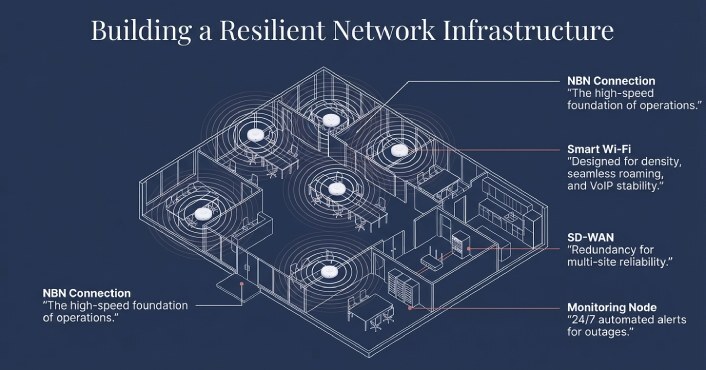
Building a Resilient Network Infrastructure
Fast, reliable internet connectivity underpins every aspect of a modern business. Melbourne IT support providers prioritise network infrastructure monitoring and design, delivering solutions built around the NBN (Australia’s National Broadband Network), advanced Wi-Fi design, and the selection of robust networking equipment.
Smart Wi‑Fi for Modern Offices
Effective office technology deployments ensure wireless coverage extends to every area of the workspace. Network administrators assess building layouts, user density, and potential interference to design solutions that provide seamless roaming, strong signal strength, and minimal dropouts supporting everything from VoIP calls to large file transfers.
Advanced Solutions: SD-WAN and VoIP Integration
For multi-site organisations and mobile teams, SD-WAN solutions streamline connectivity, enhance redundancy, and enable faster network troubleshooting. Integrating VoIP (Voice over IP) provides cost-effective communication and allows for easy scaling as the business grows. Proactive support from a trusted IT partner ensures these systems are continuously monitored, with automated alerts generated for any network issues.
Real-Time Monitoring and Infrastructure Audit
Network management involves 24×7 support, real-time monitoring, and rapid response to outages or slowdowns. Regular infrastructure audits and hardware inventory reviews help keep business operations running efficiently, reducing downtime and removing performance bottlenecks.
Backup, Disaster Recovery, and Business Continuity for Small Businesses
The Foundation of Data Protection
Small business IT support must focus on reliable backup solutions and comprehensive disaster recovery planning. Unexpected data loss whether from ransomware, hardware failure or user error—can severely disrupt a Melbourne small business. Trusted IT partners provide secure backups, both on-site and through cloud backup systems, to ensure fast and seamless data recovery.
Automated Backups and Risk Assessment
Effective IT services include automated, scheduled backups across critical endpoints and server systems. Regular risk assessments help identify vulnerabilities, while a disaster recovery team documents procedures for rapid system restoration. These processes, routinely tested by support staff, support compliance with industry security standards and help maintain uninterrupted business operations.
Ensuring Business Continuity and minimising Downtime
Downtime can be devastating for small businesses, interrupting productivity and damaging customer trust. Managed services providers such as Southeast IT and NerdSuite deliver real-time monitoring and proactive support, rapidly resolving IT issues to minimise downtime and enhance business productivity. Remote support options also ensure helpdesk availability around the clock, day and night.
Hybrid and Remote Work Enablement: Device Management, VPN, SSO, and BYOD
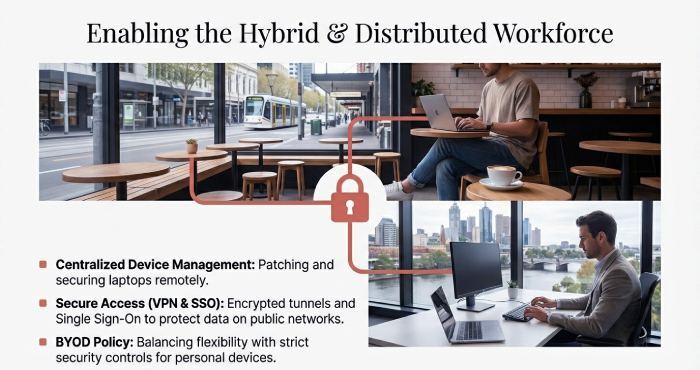
Supporting the Modern Distributed Workforce
With the rise of remote and hybrid work models, Melbourne IT support teams have prioritised maintaining a consistent user experience and strong security, regardless of location. Centralised device management ensures all endpoints laptops, desktops and tablets—are tracked, secured and regularly patched.
Secure Remote Connectivity: VPN and SSO
Virtual Private Networks (VPNs) are essential for providing encrypted remote access to sensitive business applications, protecting company data when used over public networks. Single sign-on (SSO) simplifies access, reduces password fatigue and strengthens security practices by maintaining consistent user identity across platforms.
Enabling BYOD Without Compromise
Allowing employees to use their own devices (BYOD) can improve efficiency and service flexibility, but it also introduces additional risk. IT specialists implement strict security standards and controls to ensure that personal devices accessing corporate resources comply with broader IT policies.
Continuous Remote Solutions and Support
Melbourne IT support providers deliver a combination of on-site services and remote solutions, ensuring any technical issues whether related to software setup, network configuration or computer repairs—are resolved promptly by experienced technicians. Real-time monitoring systems and automated alerts further support a mobile and flexible workforce.
Industry-Specific Support: Retail/POS, Professional Services, Healthcare, Construction, Hospitality
Understanding Unique Industry Requirements
Every industry encounters its own unique challenges. An experienced Melbourne IT support provider brings sector-specific expertise, ensuring IT solutions are tailored to specialised workflows, regulatory requirements and varying risk profiles. Whether supporting a small Melbourne café or a large professional services firm, IT issues are addressed with a clear understanding of the industry context.
Retail and POS Support
Retailers and hospitality venues require highly available POS terminals, dependable Wi-Fi and seamless customer management systems. Small business IT support in these environments includes rapid troubleshooting, secure backups of transactional data, and real-time monitoring of networking equipment and back-office systems.
Professional Services and Healthcare
Legal, accounting and healthcare firms place strong emphasis on compliance and data privacy. Trusted IT partners deliver ongoing infrastructure audits, secure website hosting and comprehensive disaster recovery planning. Solutions typically include robust software inventory management, regular system functionality reviews and secure data backup protocols.
Construction and Field-Based Operations
Construction businesses depend heavily on mobile office technology and cloud solutions to maintain efficiency on job sites. IT providers equip site offices with reliable networking equipment, remote support capabilities and device management tools that support both scalability and business continuity.
Hospitality Industry
Hotels, cafés and event spaces require highly reliable Wi-Fi, cost-effective IT solutions and responsive services to maintain continuous business productivity. Providers such as Geeks2U and NerdSuite Software work closely with local businesses across Melbourne, Australia, delivering managed services, rapid IT assistance and comprehensive support including no-fix, no-fee policies that help busy operators manage costs effectively.
Partnering with Specialists
Whether partnering with hardware suppliers or software vendors, it is essential to select a provider with a proven track record. Organisations such as eNerds and Southeast IT ensure Melbourne small businesses receive tailored, end-to-end IT support from initial hardware installation to ongoing technical assistance and network management ultimately enabling long-term business growth and resilience.
Choosing the Right Melbourne IT Support Partner
Finding a dependable IT partner is fundamental to effective technology management for any Melbourne small business. Choosing the right Melbourne IT support provider requires careful evaluation—from assessing technical expertise to ensuring alignment with broader business objectives.
Key Questions to Ask Prospective IT Providers
When evaluating IT support providers, small business owners should look beyond cost alone. Asking the right questions helps ensure you receive responsive services, technical expertise, and solutions that can scale as your business grows:
- What experience do you have supporting Melbourne small businesses?
- How do you proactively manage IT issues and technical problems?
- Which IT services and solutions do you offer specifically for Melbourne businesses?
- Do you provide both remote support and on-site services?
- How do you ensure business continuity and prevent data loss during disruptions?
- What cyber security and risk management measures do you have in place?
Leading providers such as eNerds, Southeast IT and Geeks2U bring years of experience, skilled technical support teams, and a deep understanding of local business operations, ensuring a timely and effective response to technology challenges.
Understanding SLAs: Ensuring Responsive Services
Service Level Agreements (SLAs) are a cornerstone of professional IT support for small businesses. They formalise performance commitments, ensuring your IT partner delivers on uptime, rapid response and system reliability. Leading Melbourne IT support providers should offer SLAs that include:
- Guaranteed response times
- Clear escalation procedures for critical IT issues
- Defined targets for resolving technical problems
- Real-time monitoring and automated alerts for network infrastructure
Transparent SLAs not only build trust but also help maintain productivity and minimise downtime for your business operations.
Certifications and Technical Expertise
A dependable IT provider demonstrates technical expertise through industry certifications and a team of experienced technicians. Look for:
- Microsoft 365 certifications
- Cloud platform and cyber security credentials
- Compliance with Australian data protection and security standards
Ask for details about the support team’s background ideally, your IT provider will include certified network administrators, cyber security specialists, and experts in cloud backup and data recovery. This ensures your IT infrastructure is managed securely and efficiently.
Checking References and Past Performance
References and case studies provide a valuable insight into an IT provider’s track record. Ask for references from other Melbourne small business clients and enquire about:
- How the IT partner handled past technical issues
- Their approach to disaster recovery and data backup
- Experiences with proactive support, such as infrastructure audits and network management
A reputable provider, such as NerdSuite Software or eNerds, will be happy to share success stories and demonstrate their reputation for delivering affordable and cost-effective IT solutions.
Pricing and Packages for SMB Budgets
Melbourne’s small businesses need to balance high-quality IT support with cost-effective solutions. Leading IT providers now offer transparent pricing plans designed to meet the needs of SMBs.
Per-User and Per-Device Pricing Plans
Per-user and per-device plans are common for Melbourne IT support, providing predictable monthly costs. These packages usually include helpdesk support, remote troubleshooting, and optional 24×7 assistance for business-critical operations.
Bundled IT Solutions and Managed Services
Choosing bundled packages allows small businesses to combine core IT services, such as:
- website hosting, website hosting and secure backups
- Network setup and management
- Cloud solutions, including cloud storage, migration to the cloud and cloud backup
- Monitoring services with detailed reports on system health
Managed services arrangements provide comprehensive network infrastructure monitoring and regular system updates for a fixed cost, supporting scalability and giving business owners peace of mind.
Call-Out Fees and On-Site Service Arrangements
While remote support is included in most packages, on-site services such as computer repairs or hardware setup may attract a call-out fee. Reputable providers offer no-fix, no-fee guarantees for technical assistance, meaning you only pay once the issue is fully resolved.
Billing Transparency and No-Surprises Policies
Select IT support providers that promote “no-surprises” billing with transparent terms. Regular itemised statements help you monitor spending and maximise cost savings by highlighting opportunities for hardware and software inventory management, as well as service flexibility.
Melbourne Coverage and Logistics
Comprehensive coverage across Melbourne is essential for seamless small business IT support—particularly as businesses expand from the CBD into surrounding suburbs.
City and Greater Melbourne Area Coverage
Leading IT providers such as Geeks2U and Southeast IT offer coverage across the city and suburbs, including:
- Melbourne CBD: on-site expert assistance and rapid troubleshooting
- Inner and outer suburbs: remote support with optional emergency on-site visits
This approach ensures consistent, reliable access to your IT partner, regardless of office location—essential for distributed teams and hybrid work environments.
After-Hours and 24×7 Availability
IT issues rarely stick to standard office hours. Look for IT support partners that provide after-hours service, including:
- Late evenings and early mornings to support business operations outside 9–5
- Real-time, 24×7 assistance for critical incidents and disaster recovery
A technical support team capable of off-hours service ensures the business continuity required in today’s always-on environment.
Support During Public Holidays
Public holidays can increase the risk of IT outages. Check your provider’s policy on support staff availability during holidays and long weekends. Providers that guarantee coverage whether through reduced hours or emergency tech standby help prevent costly downtime.
Onboarding Roadmap: Setting the Foundation for IT Success
Efficient onboarding ensures new clients get the maximum value from their Melbourne IT support investment from day one. A structured process can speed up the resolution of IT issues and lay the foundation for ongoing business growth.
Rapid IT Infrastructure Audit
The onboarding process begins with a comprehensive infrastructure audit, which includes:
- Hardware inventory and assessment of networking equipment health
- Software inventory across desktops, laptops, servers and cloud services
- Review of backups, backup policies and cloud storage setup
- Network management and risk assessment of existing security practices
This diagnostic enables the IT helpdesk team to quickly identify vulnerabilities and opportunities to improve productivity.
First 30-Day Quick Wins
Within the first month, your new IT provider should deliver tangible results. Common 30-day “quick wins” include:
- Resolving legacy technical issues with expert support
- Streamlining website hosting, website hosting and migration to cloud platforms such as Microsoft 365
- Implementing backup solutions to protect against data loss and enhance disaster recovery readiness
- Addressing compliance gaps, strengthening security standards and standardising system functionality
- Setting up network infrastructure monitoring with automated alerts
How to Request Same-Day Support
Responsive support is essential for small business continuity. Quality IT partners make it easy to request urgent IT assistance:
- Dedicated helpdesk email or ticketing system for rapid triage
- Dedicated phone line for same-day response to critical IT issues
- Commitment to remote support within one hour, with on-site visits as needed
Providers such as eNerds and NerdSuite ensure that small business owners’ concerns are addressed by experienced technicians, whether dealing with system outages, cyber security incidents or routine technical support.
Key Takeaways
- Choosing a Melbourne IT support partner involves assessing experience, SLAs, certifications and references to ensure reliability and technical expertise.
- Transparent pricing models such as per-user plans, bundled managed services and no-surprise billing make IT solutions both accessible and cost-effective for Melbourne small businesses.
- Proactive support with broad coverage, including after-hours and public holiday availability, ensures uninterrupted operations and rapid resolution of technical issues.
- The onboarding process should begin with a comprehensive infrastructure audit and deliver noticeable improvements within the first 30 days, laying the groundwork for efficiency and effective risk management.
- Fast and flexible support channels ensure that both minor and critical IT problems are addressed promptly, minimising downtime and supporting business growth.