
The key benefits of working with a managed services provider (MSP) for small businesses include measurable cost savings (across hardware, software, staffing, and downtime), stronger cybersecurity with 24/7 monitoring and incident response, improved uptime through disciplined operations and disaster recovery, faster cloud and technology adoption, enhanced compliance readiness, predictable pricing with SLAs, and access to enterprise-grade tools and expertise that scale alongside your business.
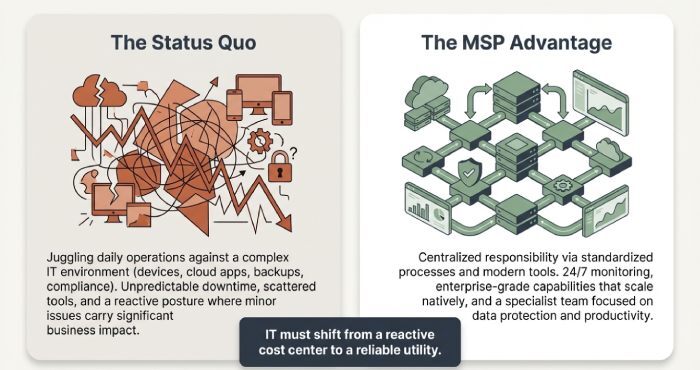
Small businesses often balance day-to-day operations with an increasingly complex IT environment: devices, cloud applications, cyber security controls, backups, and compliance obligations where even minor issues can have a significant impact. An MSP centralises these responsibilities using standardised processes, modern tools, and specialist teams operating at scale, transforming ad hoc IT into a reliable, outcome-driven service focused on uptime, data protection, and productivity.
To clearly demonstrate MSP value, small businesses should assess benefits in both financial and operational terms: total cost of ownership (TCO), risk-adjusted loss prevention (such as ransomware), revenue-protecting uptime improvements, and speed to capability (for example, secure cloud adoption). This guide pairs each benefit with practical steps and shows how AWD our managed services platform delivers measurable outcomes through modular services like AWD Shield (security), AWD Continuity (backup/DR), AWD Comply (compliance), AWD Migrate (cloud), and AWD Insight (reporting), all governed by AWD’s Control Plane and Service Catalogue.
The Business Case: Quantifiable Cost Savings With an MSP (and How to Model Them)
What costs you can reduce
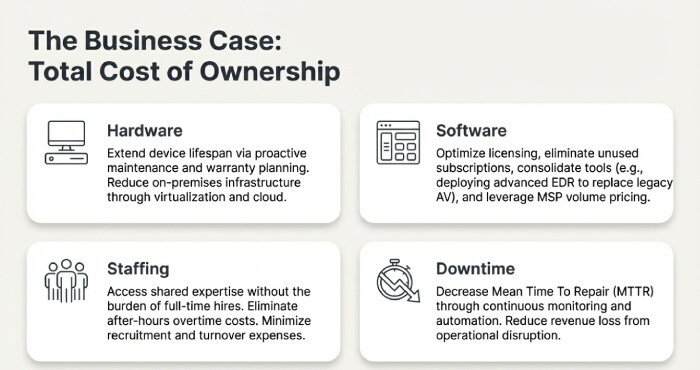
- Hardware: Extend device lifespan through proactive maintenance and warranty planning; reduce on-premises infrastructure via virtualisation and cloud.
- Software licensing: Optimise licences, eliminate unused subscriptions, consolidate tools (e.g., EDR replacing traditional antivirus), and leverage MSP volume pricing.
- Staffing: Reduce reliance on full-time IT hires by accessing shared expertise; eliminate overtime costs with after-hours support; minimise recruitment and turnover expenses.
- Downtime: Decrease mean time to repair (MTTR) through monitoring and automation; reduce revenue loss caused by outages and operational disruption.
How to quantify and project savings
- Baseline TCO (12 months): Hardware refresh + software licensing + internal IT salaries/benefits + tool subscriptions + downtime costs + incident recovery.
- MSP scenario: MSP subscription + onboarding costs + retained internal roles.
- ROI formula: ROI% = [(Baseline TCO − MSP Scenario) ÷ MSP Scenario] × 100
- Payback period: Onboarding cost ÷ monthly net savings
- Downtime cost: Revenue/hour × gross margin + (staff cost × productivity loss)
Example (50-employee firm)
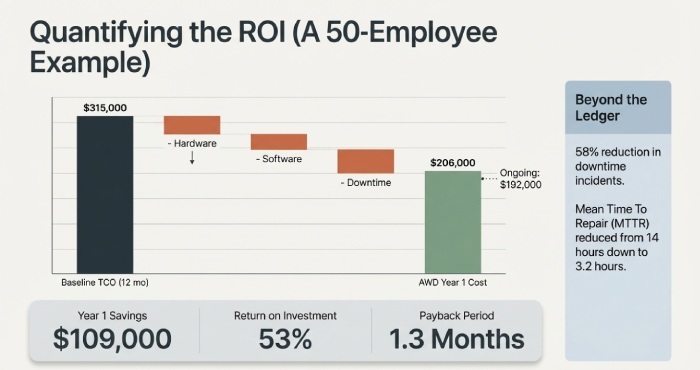
- Baseline: $315k/year
- MSP (AWD): $206k (year 1), $192k ongoing
- Year 1 savings: $109k
- ROI: 53%
- Payback: 1.3 months
- Additional outcome: 58% reduction in downtime incidents; MTTR reduced from 14 hours to 3.2 hours
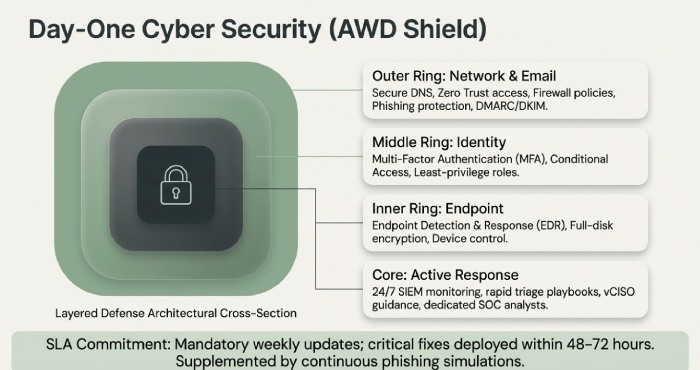
Building an MSP-Driven Cyber Security Program That Works on Day One
Core controls every small business should implement
- Identity and access: Multi-factor authentication (MFA) conditional access, least-privilege roles
- Endpoint security: EDR, encryption, device control
- Network security: Secure DNS, firewall policies, Zero Trust access
- Email and SaaS: Phishing protection, DMARC/DKIM, data loss prevention
- Patching: Weekly updates; critical fixes within 48–72 hours
- Backup security: Immutable backups and regular restore testing
- User training: Phishing simulations and awareness programs
Monitoring and response
- 24/7 monitoring using SIEM and EDR
- Incident response playbooks with rapid triage
- Defined roles: vCISO, security operations center (SOC) analysts, engineers
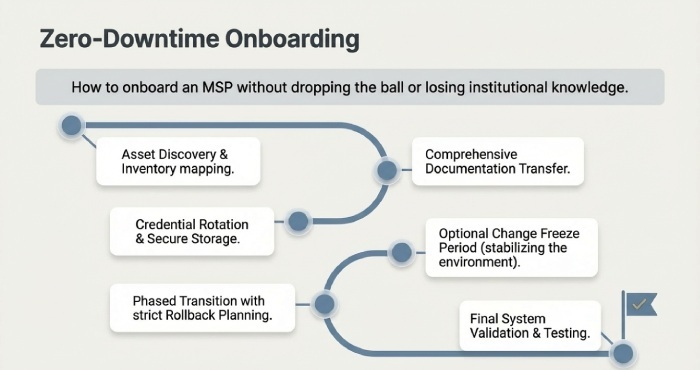
Onboarding an MSP Without Downtime or Knowledge Loss
Best-practice onboarding steps
- Asset discovery and inventory
- Documentation transfer
- Credential rotation and secure storage
- Phased transition with rollback planning
- System validation and testing
- Optional change freeze period
Making Sense of MSP Pricing, Contracts, and SLAs
Common pricing models
- Per-user: Best for cloud-focused businesses
- Per-device: Suitable for hardware-heavy environments
- Tiered plans: Simple but may hide limitations
- Cloud-based pricing: Scales with usage
Key contract terms
- Uptime guarantees (e.g., 99.9%)
- Response and resolution times
- Backup and recovery targets (RPO/RTO)
- Reporting transparency and review cadence
- Exit terms and data portability
Disaster Recovery and Business Continuity You Can Trust
What MSPs should provide
- 3-2-1-1-0 backup strategy
- Defined RPO and RTO targets
- Cloud-based failover options
- Regular testing and validation
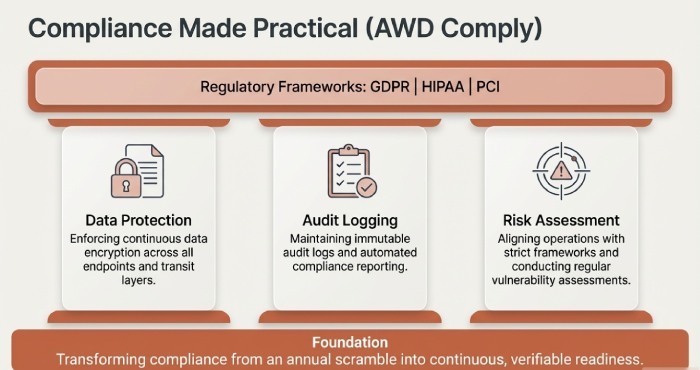
Compliance Made Practical: GDPR, HIPAA, PCI
MSP support areas
- Data protection and encryption
- Audit logging and reporting
- Risk assessments and compliance frameworks
Cloud and Hybrid Migrations Without Disruption
MSP migration approach
- Assessment and planning
- Secure design and pilot testing
- Phased migration with minimal downtime
- Ongoing optimisation
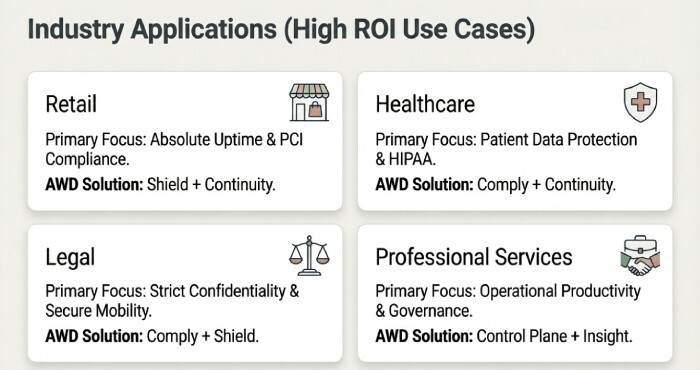
Industry Use Cases With High ROI
Retail
- Focus: uptime and payment security
- AWD: Shield + Continuity
Legal
- Focus: confidentiality and mobility
- AWD: Comply + Shield
Healthcare
- Focus: patient data protection
- AWD: Comply + Continuity
Professional Services
- Focus: productivity and governance
- AWD: Control Plane + Insight
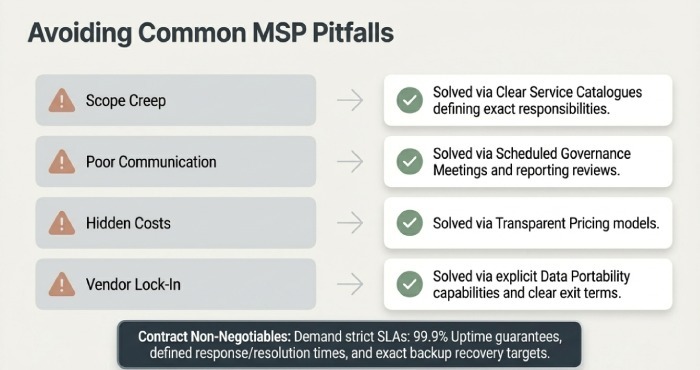
Avoiding Common MSP Pitfalls
Risks
- Scope creep
- Poor communication
- Hidden costs
- Vendor lock-in
Solutions
- Clear service catalogues
- Regular governance meetings
- Transparent pricing
- Strong exit clauses
The Metrics That Prove MSP Performance
Key metrics
- Uptime and availability
- MTTR and response times
- Security incidents and patch compliance
- Backup success rates
- Cost optimisation
FAQs
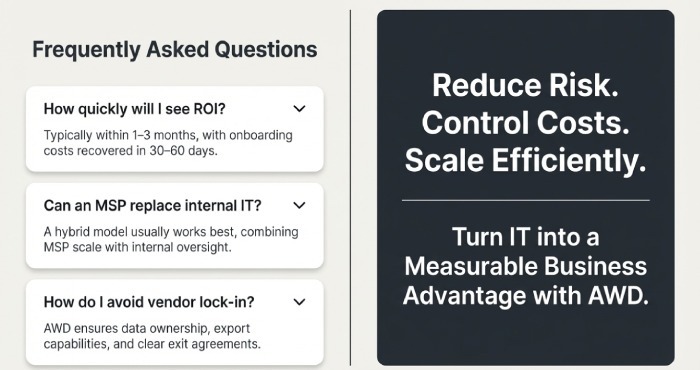
How quickly will I see ROI?
Typically within 1–3 months, with onboarding costs recovered in 30–60 days.
Can an MSP replace internal IT?
Usually a hybrid model works best, combining MSP expertise with internal oversight.
What should be included in an MSP agreement?
Scope, service level agreement(SLAs), security standards, reporting, and exit terms.
How do I avoid vendor lock-in?
Ensure data ownership, export capabilities, and clear exit agreements.
Conclusion: Turn IT Into a Measurable Business Advantage With AWD
Working with an MSP enables small businesses to achieve predictable costs, stronger cyber security, improved uptime, faster technology adoption, and simplified compliance all backed by measurable outcomes.
AWD brings these benefits together through a structured, modular approach: seamless onboarding, proactive security, reliable backup and recovery, compliance automation, cloud optimisation, and transparent reporting. For businesses aiming to reduce risk, control costs, and scale efficiently without increasing headcount, AWD transforms IT into a strategic advantage.